

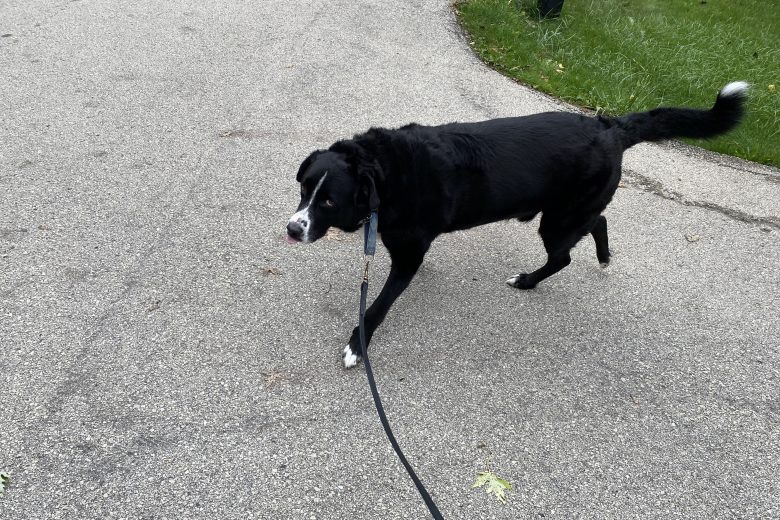
One of the toughest things to deal with as a dog walker is a dog reacting to an outside stimulus while on a walk.
The five seconds before can be the difference between a wonderful walk and a stressful one.
Whether it’s another dog, a person, a car, a truck, a lawn mower, or any number of things, when a dog reacts hard and begins barking and pulling on the leash, it can easily lead to injury for me or the dog.
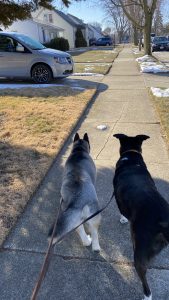 I get to know the triggers of the dogs I regularly walk and also work with them to help prevent reactions. But when it’s a new dog, I won’t know the dog’s triggers.
One of the strategies I’ve perfected over the years is keeping my head on a swivel, glancing from side to side and always looking forward in anticipation of possible triggers.
This lets me see problems before they arise, and I can be prepared to take the action necessary: crossing the street, turning onto another street, turning around and going back the way we came, or distracting the dog. Getting them to use their nose by smelling the grass works amazingly well.
I also watch the dog’s body language closely on a walk. If the ears suddenly perk up, the head turns sharply, or the hackles go up, I know the dog has sensed something I’m not aware of and probably need to become aware of.
I’ve always said, if a dog snaps its head to the side, I better snap mine there too.
There are times when I don’t have five seconds to prepare. Meeting another dog walker at a corner, a dog barking from indoors or outdoors, or a dog charging a fence can cause problems to arise quickly. Usually, it’s too late to stop my dog from reacting, so I do all that I can to keep everyone safe.
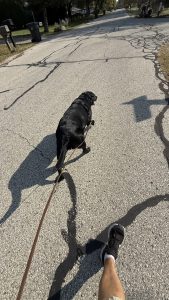 I stay calm, shorten the leash for control, and position my body so it takes the load of the pull instead of my arms.
I try to keep moving and get away from the trigger. But with some dogs, that isn’t best. They aren’t paying attention to where they are. They can trip you, turn into your knee, or step hard on your foot. In these cases, I stand still and let the trigger pass, keeping control of my dog so no one gets hurt.
I can’t always stop a dog from reacting. But due to my understanding of triggers, knowledge of dog behavior, and always looking five seconds ahead for possible trouble, I’ve never had an injured dog. Or an injured Steven.
And when a dog succeeds and doesn’t react, it gets all of the praise and love that it deserves. Because stopping emotional triggers isn’t easy for anyone.